Before the First Mower Cranks: Winning the Whole Block With One Sign
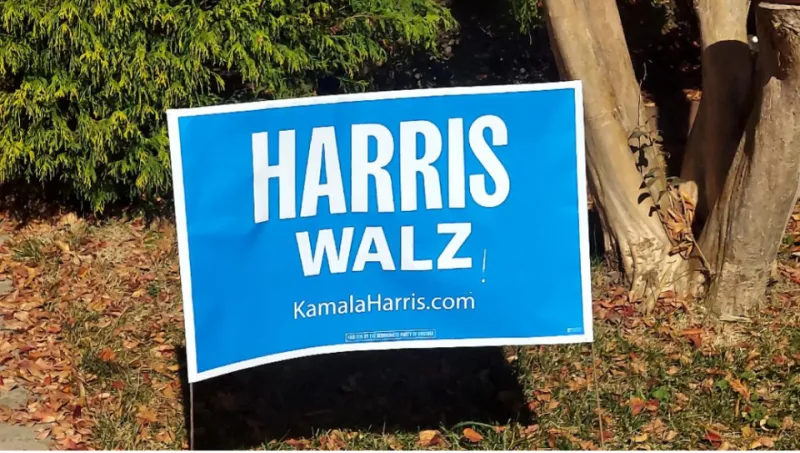
Photo: Mdnavman, CC BY-SA 4.0, via Wikimedia Commons
Every November, America runs the biggest yard sign experiment in the country. Thousands of campaigns, from school board to Senate, spend real money on corrugated rectangles staked into frozen lawns — and they do it because the math works. Meanwhile, most landscaping and home service crews wait until March, scramble for spring bookings, and hope the phone rings.
That's the gap. Campaign-style sign strategy, borrowed honestly, can have your company name planted across a subdivision weeks before your competitors even think about the season. Here's how to run it like a pro.
Placement Beats Quantity Every Time
Campaign operatives live by a simple rule: a sign nobody drives past is a sign that doesn't exist. They don't scatter signs randomly — they map them.
You should too. The best spots for a home service crew are the same ones campaigns fight over:
- Corner lots at neighborhood entrances. Every car coming home passes them twice a day.
- Jobs in progress. A sign in the yard of a house you're actively transforming is the most credible ad you'll ever run. Neighbors can literally see the work.
- Post-job placement. Ask your happiest customer to let the sign stay up for two weeks after you finish. "Ask Dave at 114 Maple" energy, but with your logo and number.
One more campaign trick: angle signs toward oncoming traffic, not straight at the road. A sign tilted fifteen degrees toward the driver gets noticed; a flat-on sign becomes wallpaper by Wednesday.
The Saturation Effect (Why Three Signs Beat One)
Here's the counterintuitive part. Political data folks will tell you a single sign does almost nothing. Three signs in a half-mile radius? That's when something clicks. The third time a resident sees your name, it stops being an ad and starts being a fact — these guys must be all over the neighborhood.
That perception of momentum is the whole game. Nobody wants to be the first house on the block to hire you; everybody wants to hire the crew their neighbors apparently already use. Saturation manufactures that social proof out of thin air and about forty bucks of coroplast.
A practical target: five to eight signs per subdivision, concentrated. Not spread across town like confetti.
Know the Rules Before You Stake
Nothing kills a rollout faster than a code enforcement officer with a clipboard. Sign ordinances vary wildly across US towns and counties, so spend one afternoon on your municipality's website (or one phone call to city hall) and confirm:
- Whether commercial signs on residential property are allowed at all — some towns ban them outright or limit them to homes where work is being performed
- Size limits (most residential rules cap signs somewhere between 4 and 6 square feet, which is why 18x24 is the sweet spot)
- Duration limits — how long a sign can stay up
- Homeowners association rules, which are often stricter than city code
The "work being performed" exception is your friend in strict towns. A sign on a job site is usually legal even where general advertising isn't — one more reason job-site placement wins on every count.
The Cost-Per-Impression Math
Let's run numbers, because this is where yard signs embarrass everything else in your marketing budget.
Say you print ten 18x24 signs for around $150 total. Placed well in a subdivision with 200 homes, conservative estimates put each sign at 500+ daily drive-by impressions. Ten signs, thirty days: you're looking at 150,000 impressions for $150. That's a tenth of a cent per impression. A postcard mailing runs 50 to 75 cents each. Facebook ads might hit you at a few cents per click, with no guarantee the clicker owns a lawn.
Even if only a handful of homeowners call — and they will — you need exactly one mid-size landscaping job to pay for the entire campaign several times over.
Your Week-by-Week Rollout
Timing is the third leg of the campaign stool. Signs that go up too early get weathered and ignored; too late and the bookings are gone. Working backward from your first spring mow or paint day:
Weeks 1–2 (early February in most of the country): Print. Order 10–15 signs — big, readable type, your phone number, and a short URL or QR code. Skip the paragraph of services; nobody reads it from a car.
Weeks 3–4: Seed. Place signs at two or three of last year's best jobs (with a thank-you note and a small discount on their spring service as the ask). Hit the neighborhood entrances. This is your saturation phase.
Weeks 5–6: Rotate. Swap tired-looking signs to fresh corners. Add a sign at any early-season jobs you've booked — momentum on momentum.
Weeks 7–8: Convert. As calls come in, ask every new customer: "Mind if we keep a sign up for two weeks after we finish?" Now your campaign runs itself, and by the time your competitors' trucks are finally unwrapped from winter storage, half the subdivision already has your number saved.
Print It Like You Mean It
One last thing from the folks who print these things all day: a flimsy, washed-out sign costs the same to stake as a sharp one, but it works half as well. Go with UV-resistant inks, a step stake or H-frame that survives wind, and type you can read at 35 miles per hour. Three colors, your logo, your number. Done.
Campaigns spend millions learning what a $15 sign can teach a local crew. This spring, plant your name before anyone else's shows up — and let the neighborhood do the selling.